
What Is a PESTEL Analysis?

- ZARYAB
You might have heard the term “PESTEL analysis” in a business class or meeting. But what exactly is a PESTEL analysis? In plain language, it’s a tool that helps you look outside your company. It lets you see what’s going on in your external environment. The idea is simple: things like politics, the economy, society, technology, the environment, and laws can all push or pull your business.
In this article, we’ll explain what a PESTEL analysis means, how you do one, when to use it, and real life examples. By the end you’ll know why it matters for strategy, planning, and staying ahead.
Why a PESTEL Analysis Matters
Think about this: your business doesn’t sit alone. It moves within a world that’s always in motion. Governments adjust their policies. Economic cycles rise and fall. Social values shift. Technology keeps pushing limits. The planet asks for more care. And laws shift to keep up. A thoughtful PESTEL analysis helps you see these changes before they reach your doorstep.
Here’s what a strong PESTEL analysis can do for you:
- A PESTEL analysis helps you see what’s happening outside your business. It shows both the threats and the chances waiting in the world around you.
- It gives a clear picture of the forces you can’t control but must understand — politics, economy, society, and more. With this insight, you can plan smarter and avoid surprises.
- PESTEL fits perfectly with tools like SWOT. SWOT helps you understand what’s strong or weak inside your business, while PESTEL shows what’s happening outside.
Many business experts call it one of the best ways to study outside forces. It helps you prepare for changes instead of being caught off guard.
In simple words, if you ignore what’s happening around your business, even a great plan can fall apart before it begins.

The Six Key Elements of a PESTEL Analysis
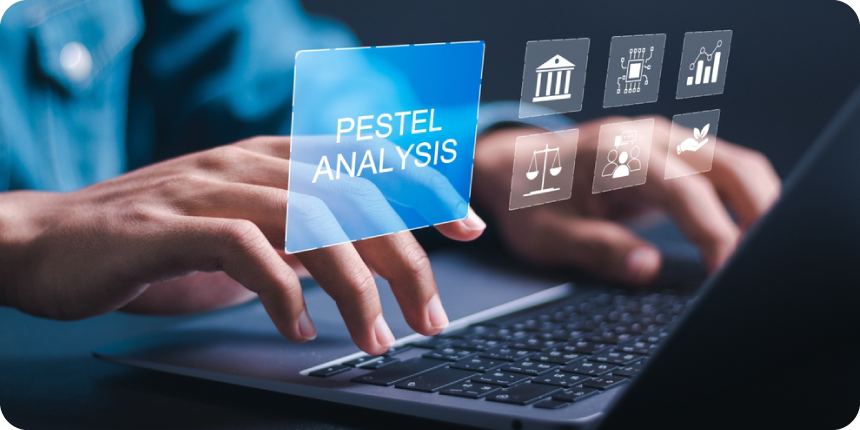
A PESTEL analysis has six parts. Each one looks at something outside the business that can change how it works or grows.
Political Factors
Politics shape how a business runs. Governments make rules that affect trade, taxes, and jobs. When new laws come, companies must adjust.
When taxes of a country on imports are increased, then products become expensive. New leaders have the ability to transform business rules when elections occur. Proper planning makes companies be prepared to change.
Other things such as labor laws, trade deals, and government support are also considered to be politics. These are factors that determine the ease or difficulty of conducting business in a country.
Economic Factors
Money runs the world of business. When the economy is strong, people earn more and spend more. Shops stay busy, and companies grow fast.
But when things slow down, people save instead of buying. Prices rise, bills pile up, and sales drop. That’s when businesses feel the pressure.
Interest rates also play a big part. High rates make loans costly, while low rates make borrowing easier. And if the local currency loses value, importing goods gets expensive, but exporting can bring in more money.
So, keeping an eye on the economy isn’t extra work. It’s how smart companies stay prepared and make the right moves when the market changes.
Social Factors
Social factors are all about people, how they live, what they value, and what shapes their choices. These things influence what they buy, how they spend, and even what they believe in.
When more people start caring about health, the demand for fast food drops. When young people get excited about new tech, they rush to try the latest gadgets.
Population, education, lifestyle, and family patterns all play a part. The more a business understands people’s values and habits, the better it can connect with them and stay relevant.
Technological Factors
Technology moves at a speed that never slows down. New tools and systems make work easier and faster. Companies that use new tech often lead the market.
For example, YouTube turned online videos into a daily habit for millions. New apps, AI tools, and machines can also lower costs and improve service.
Every company should ask: What new tech can help us grow? Staying updated keeps a business ready for the future.
Environmental Factors
The environment is now a big part of business planning. Climate change, pollution, and resource use affect how companies work.
Many brands are using clean energy or eco friendly packaging. Customers also care about sustainability. A green image builds trust.
If a company ignores the environment, it can lose customers and face fines. Taking care of nature is now part of smart business.
Legal Factors
Laws protect people, workers, and the market. A business must follow all rules about products, safety, data, and employees.
Breaking a law can hurt the brand and cost a lot of money. For example, companies that sell online must protect customer data.
Legal changes can also bring new chances. A new rule may help some industries grow faster. Knowing the law keeps a company safe and ready for new doors to open.
In short, each part of PESTEL shows how the world outside affects business inside. Political, Economic, Social, Technological, Environmental, and Legal factors together give the full picture.
Smart companies don’t just react, they plan ahead. PESTEL helps them see what’s coming and take smart steps to stay ahead.

How to Conduct a PESTEL Analysis
Here’s a practical step by step guide to doing your own PESTEL analysis:
Define the scope
Decide what you study. The whole company, one market, or a new product? Keep the focus clear.
Gather a team
Ask people from different parts of the business to help. More views catch more issues.
Brainstorm the factors
For each PESTEL letter, list what you see in the outside world. Write down politics, the economy, social changes, tech moves, environmental issues, and laws.
Research and collect evidence
Find reports, articles, and data to back up your list. Use reliable sources. Don’t rely on gut feeling alone.
Evaluate each factor
Decide how likely it is to happen. Then rate the impact it would have. Use a simple scale like low / medium / high.
Prioritize and act
Pick the biggest risks and the best chances. Turn those into actions or strategy items.
Assign owners and dates
Give each action to a person. Set a due date. That keeps things moving.
Review regularly
The world changes fast. Check your PESTEL every 6-12 months, or when big events happen.
When to Use a PESTEL Analysis
You might ask: “When should I do this?” You can use a PESTEL analysis in many scenarios, such as:
- Launching a new product or entering a new market
- Adapting strategy in times of change (economic downturn, technology shift)
- Annual planning or refresh of the business strategy
- Risk assessment and scenario planning
Because the external world shifts, revisiting the PESTEL analysis every 6-12 months is a good idea.

Real Life Example of a PESTEL Analysis
Imagine that you start an electric car company. A PESTEL analysis that you would use would be:
- P — Political:
Many governments now support electric cars. They offer tax breaks and grants, but new trade rules or import taxes can change costs quickly.
- E — Economic:
The price of materials like lithium keeps going up. People’s income and loan rates also affect how many can afford your cars.
- S — Social:
More people want cleaner options. Cities are busier, and many drivers prefer quiet, eco friendly cars that fit their lifestyle.
- T — Technological:
Battery technology is improving fast. Charging stations are growing, and features like self driving are becoming more common.
- E — Environmental:
The laws against global warming compel businesses to reduce their emissions. However, it may remain challenging to locate sustainable materials.
- L — Legal:
Car safety rules are strict. Plus, new privacy laws control how you collect and use driver data.
When you map these out, you can spot threats (rising raw material cost) and opportunities (government tax credits). That helps you shape your strategy rather than react.
Pros and Cons of a PESTEL Analysis
Like any tool, a PESTEL analysis has strengths and limits.
Advantages:
- Gives you a broad view of your environment.
- Helps anticipate future changes.
- Encourages strategic thinking beyond day to day operations.
Limitations:
- Don’t analyze your internal strengths and weaknesses (that’s what SWOT does).
- Can become basic if you only list factors without deeper insight.
- Requires regular updates so it stays relevant.
Conclusion
Doing a PESTEL analysis is like taking a step back to see the bigger picture. It helps you understand what’s happening around your business, the trends, the risks, and the chances waiting to be used.
When you ask, “What’s changing out there, and how could it affect us?” you start thinking ahead instead of reacting later. That’s how strong strategies are built, by staying aware and prepared.
So take the time. Gather your team, look at your market, and do your own PESTEL check. Use it to guide your next move and shape the future you want for your business.
Frequently Asked Questions
What is the difference between PESTEL and PEST?
PEST focuses on Political, Economic, Social, and Technological factors. PESTEL adds Environmental and Legal factors.
How often should we update our PESTEL analysis?
Ideally, you should review and update it at least every 6-12 months because the external environment changes.
Can small businesses use a PESTEL analysis?
Yes, even small companies can benefit. It helps them view their environment and plan. They might not cover every detail, but the framework still works.
Should a PESTEL analysis replace SWOT?
No, it complements SWOT. While PESTEL looks at external factors, SWOT covers internal strengths and weaknesses. Use both for full insight.
With over 8 years of hands-on experience in Search Engine Optimization (SEO), Zaryab Khan is a seasoned professional dedicated to enhancing online visibility and driving organic growth for businesses worldwide. Holding a Bachelor of Science in Computer Software Engineering from National Textile University, Zaryab combines technical proficiency with strategic insight to deliver measurable SEO results.

At SEOstrategi, we are your growth partners, focused on helping your business succeed with tailored strategies, expert support, and a commitment to increasing visibility, traffic, and conversions in Norway.